Vitals
born-
July 1875 or 1876 in Wisconsin (per Joyce 23 JUL 1875 Manitowoc,Wis)
died-
before 1930 in Fruitport Michigan ( per Joyce 10/28/1928 Spring Lake Cemetery ,Spring Lake, Michigan by a drunk driver)
father-
Johann Peter Heinrichs
mother-
Rosalia Eckardt Heinrichs 1850
siblings
married-
1895 in WI Charles Andrew Smalley1875
children-
Rosalind Marguerite 1897, Orin Fitch 1898 , Francis Earl 1899, Margaret Lucille 3/10/1902, Clarice Bertha 2/19/1905, Charles Raymond 1/29/1907, and Clarence Christian 3/31/1913.
http://genforum.genealogy.com/smalley/messages/1002.html
 |
| Bertha with granddaughter Rosemary |
from the files of Joyce Alverson:
"TO OUR PARENTS
( In Memoriam )
We were lucky
When we were young
With trees to climb
And fields to run -
With songs in our hearts
And songs that were sung -
With stories heard -
Like "The Indian Drum".
The Christmas nights -
The apple fights -
The big oak tree -
"All sorts are free!"
Penny candy ( slightly sandy )
Dad's love fro" Bers ",
His Universe.
We seee it yet -
In retrospect.
Our security, our content,
Our happiness was there -
And we children owe all this
To a much beloved pair.
CBS
Clarice Bertha Smalley Smith
""WE REMEMBER"
Memoirs of the family of Charles and Bertha Smalley 1978
Orin F.
I remember back to about 1903 - I was about 4 years old. 1412 Logan Ave.,
Marinette, Wisconsin.
I remembered the address when Evelyn and I took a trip around Lake
Michigan...but that is a later chapter. Rosalind is about the only one besides
me that could remember that house. It was a big house - also had a barn in
back with an upper storey.
Laducks lived across the street, and Snyders lived 3 doors east; also Hurdeys
lived next to Snyder's place, and Popes lived on the west corner of Pierce
Avenue.
Let me tell you about Popes first: They had two boys, Percy and Wesley. Now, I
liked Wesley best because I knew him better. "You know, I was only 4 years
old." Well, I was so proud of Wesley. He had a paper route and he let me go
along and help him deliver his papers.
You know our street wasn't paved in those days. We had a big gas light on the
corner and a man had to come along every night and light it. He had to let it
down so he could get at it.
I know all the kids in the block played games there. I remember one called
"Pussy Wants a Corner".
We played until about 8 p.m.; then our dear mother would call, "Children - time
to come in now - it's eight o'clock."
Mother went to the hospital for all the kids, I guess. It must have been Peg
this time, as I remember we had Minnie Hanson to take care of the rest of us.
I guess I was the one that had a bright idea to build a bonfire. Guess where?
You're right - upstairs in the barn. When she finally got it out, a big hole
was burned in the upstairs barn.
You know, Dad always bought cord wood. Frank and I piled up about 3 cords of
wood. Dad gave us a nickel between us and we were tickled to death!
You remember Uncle Herman and Aunt Margaret, who lived in Monnomenee? Our
Mother gave us carfare to go visit them (Frank and I). Wou know I could talk
Frank into anything, and I liked to play baseball. Well, I talked him into
walking both ways and saved the money (20 cents). So I bought a new baseball.
As I write this, it's near Halloween, and I just thought of that wood pile. The
kids liked to tip over wood piles. Dad took his double-barrel shotgun and
filled it with rock salt. I don't know whether he hit anyone or not.
Oh, I remember Marinette all right. Dad worked at the Stevens' Shop one time.
In those days they had all overhead belts to run the machinery (leather belts).
I thought they were made of rubber. Oh, boy! If I could only get one of those
belts, what a great sling shot that would make!
Now we are starting our trip to Manitowoc. We took the train. Mother fixed a
box lunch for us. Quite a trip. All I remember was Little Swanigo and Big
Swanigo. Well , we finally arrived in Manitowoc and stayed for awhile at Uncle
Frank's (Mother's uncle). Dad got mad at Uncle Frank when he made a bad remark
at Peg. So we left there and Dad rented a small house near the Lincoln School,
right across from a Catholic school. We always had fights with them.
The school was on 7th Street and there was a big hill there. We had a big
bobsled. The big kids would ice the hill in the road and we slid all the way to
the river. Then we would haul the sled back and slide down again. You know,
there weren't many cars then. The milk man had a horse and wagon and one time
we slid right under the horse. That was the end of that.
We moved to our ten acres on the city limits. We really had a great time there
- had a large brick house right on the point of 12th Street and the old plank
road. Had a large old apple orchard and a big garden spot where Frank and I
raised sweet corn and a lot of cucumbers. We peddled them in town and got $l.00
for a half peck of small pickles. That is where we got old Betsy. She was a
fine Holstein cow and we got 13 guarts to a milking. We also took her with us
when we moved to Casnovia, Michignan. Does anyone remember that big barn?
Frank and I built a dove cote in the very peak of that barn. Had a bunch of
doves and had to cut holes in the side for them. Well, poor Frank and I had to
clumb up to the dove cote. It all ended one day when Frank lost his hold and
fell down and broke his arm. Dad made me get up there and tear it down.
I had two paper routes and trotted all around them. Mother called it Orin's
little dog trot.
I guess we lived there five or six years. I remember 1910 when the Titanic was
sunk. Boy, I made a lot of money that day! I bought a whole bundle of Chicago
Extras for a penny each and sold them for 5 cents each.
I guess it was 1912 when we made our trip to Casnovia. We rented a box car for
the livestock and took a car ferry from Manitowoc to Ludington, Michigan.
Someone had to go with the livestock, so I asked to go with Dad. We got as far
as White Cloud, but had to lay over there for two days. Dad and I had to go out
and buy some hay for Betsy and food for the pigs and for ourselves. Mother had
all the money and Dad only had $1.00. Oh, boy, that was some experience!
We finally landed at Casnovia and all the family were at Uncle Hank';s farm. We
finally got our own famr - 20 acres. I was through 8th grade then, so I didn't
have to go to school. I worked on farms and at the dehydration factory. I made
$9.00 per week and gave it to Mother. I wanted to help pay for that darn farm.
Well, Dad finally moved us again - to Muskegon Heights on Marion Avenue near
Mona Lake. I remember that cemetery, Mother got a prize for naming it. She
called it "Mona View".
While there, I enlisted in the Marines for the duration of the war. I remember
the day I came home I was wearing that bright green uniform. Clarice came to
the door and hollered, "Oh, here is a telegram boy!" I felt real bad about
that.
Then we moved to Fruitport - and I guess I'd better call it quits. I hope you
don't get tired of reading this. I just did the best I could.
'WE REMEMBER'
Memoirs of the family of Charles and Bertha Smalley 1978
Francis E.
Francis Earl, later called Frank, was born on May 10,1900, in Manitowoc,
Wisconsin. He was married to Ellen Johnson in Muskegon, Michigan.
A daughter, June Ellen, was born in Muskegon. She was a special delight and
satisfaction to her parents. She finished her training for teaching at Western
Michigan University. After graduation she taught near Ann Arbor, where her
husband finished his training for dentistry.
Now established as a dentist in Spring Lake, Mighigan, Dale and June Ellen
DeBoer are enjoying their two daughters, Dawn and Joan, and their small son,
Peter.
We miss Frank at our family reunions which he so much enjoyed each July at the
Lake Michigan beach.
He is the first of our family with whom we had to part. He died in March, 1972,
of a heart attack, while helping a neighbor clear the ice from his driveway.
This last helpful act was characteristic of his usual thoughtfulness and desire
to be of help.
By his sister Rosalind
Uncle Frank was a delight for his small neices. He would arrive and toss us
into the air...or grab our knees and make us call uncle.. as we grew older he'd
change it to "I love------".
His farm was intriguing huge dairy barn, electric milkers, huge milk cans,
rolling lawns and such grand smells came from Aunt Ellen's kitchen. He made us
feel special!!. Thanks Uncle Frank!
By a neice Joyce Colburn
"WE REMEMBER"
Memoires of the family of Charles and Bertha Smalley 1978
Margaret L.
My earliest recollection is when I was a tiny tot. I think I was about two
years old. I don't recall a baby younger. We were at a picnic, and I had on a
little blue dress and got all wet. Must have been at a lake. Mother changed my
clothes, put on a pink dress and I had to just sit__on the bench. It is very
vivid to me.
Then, when we lived at 1412 Logan Ave in Marinette, I must have been 4 that
Easter morning when, in the chichen coup, I found speckled candy Easter eggs
that the bunny left. I was so excited!
Then, remember when Mama had typhoid and we kids were all "farmed out" with Aunt
Margaret's relatives? Rosalind had baby Charles with her. I was homesick and
the people I stayed with had me watch them chop a chicken's head off! Ugh! I
tried to get Clarice to play, but they wouldn't let me call her because she was
taking a nap.
Another time we were both going to Pope's for supper. Dad called us to come
home because we had a baby brother. Clarice ran home, but not me. I was going
to eat at Pope's, and nothing was better than that.
Remember how we would walk through the fields full of daisies and devil's paint
brushes to meet Papa and see if he had left anything in his dinner bucket?
When I had croup so bad, I thought Mrs. LaDuke was going to have Papa throw me
in the coal stove. Instead he brought a mixing spoon of goose oil and
trupentine to pour down my throat. I was sleeping with him at the time. Guess
Mother had Clarice, who was a baby at the time, in another bedroom.
I remember going to Aunty Stern's for Christmas. She always had those white and
chocolate kisses (cookies). Dad used to play with us. We had lamps and he had
baby (Chick) on his shoulder and pillow and was chasing us around the table. I
ran that darning needle in my foot. Remember the blood-curdling yells I let out
when that needle hit a nerve? It's still there someplace.
Then Buffalo Street, Manitowoc, and how Rosalind laid in bed and moaned when I
called her when I was coming upstairs. Boy, Rosalink and Clarice sure liked to
scare me and I was so scary.
Then good old Plank Road. We sure had good times there. Remember Uncle Dan
bringing the brewery horse and sleighs on holidays? Remember Maude, our horse,
and those two fellows on motorcycles scaring her? Our big oak tree and that big
swing, and the bee fights and apple fights and hide-and-seek, when we hid in the
big barn in the hay mow and sometimes in the lousy hens' nests?
I remember when Clarice came screaming into the house. She had been in the
chicken coup and was covered with lice. After that, the coup was whitewashed.
Then Casnovia and how excited we were to go on the train. Did we come across on
the boat? Dad, Orin and Frank came in a freight car with the cow. How much fun
it was to go to Badell's and have Aunt Clara Play the piano and sing "Redwing."
Sliding down that big hill in Casnovia. Mama and Papa took me to a dance at
Casnovia one night.
Remember how Dad rode his bicycle to Muskegon and home to Cas. weekends? What
an awful long ride that must have been. What sacreficing parents we had. Did
we really appreciate all tey did for us? How Mother traded her stem-winding
watch so I could have a wrist watch. How I have wished that she hadn't.
Oh, yes! At Fruitport...the apple fights with the boys and Dad. Dad would
laugh 'til the tears ran down his cheeks when he would make a direct hit; but
watch out when one hit him! He would yell, "That's enough, boys! We quit right
now."
Here's a funny one! Orin was home and sitting in the outdoor toilet. Andy,
Chick and Clarance sneaked up and tipped it over on the door side. Orin stuck
his head through the hole and yelled for Mother until she came out and saw what
had happened. She said, "Turn it back, boys". But she had to turn her back on
them 'cause she was laughing so hard. It was quite a sight. Too bad someone
didn't take a picture.
I guess I wasn't a very loveable child, but Mother never made me feel that way
except for telling me, one time, she hoped I had a child just like me, and also
that I would try the patience of a saint. Believe me, she was a saint to me,
and everyone of her remarks I have always remembered and cherished. Rosalind,
my dear sister, is very much like her. I couldn't give her a more sincere
compliment.
As I sit here reminiscing over my past life, how I would like to live it over
and I sure would change a lot of things. One thing I wouldn't change, though,
is my family. God has been good to me. I am so thankful for all of His
Blessings and our wonderful parents He gave us. I am sure we all feel that way.
"WE REMEMBER"
Memorirs of the family of Charles and Bertha Smalley 1978
Charles Raymond
CHAPTER ONE
Now hear this: I am Charles Raymond Smalley. I have been called other things
in the past seventy years, but I prefer "Charles". I was born in the sleepy
town of Marinette, Wisconsin, January 29th, the Year of Our Lord 1907. My birth
certificate states January 28th but I suppose, with all the fanfare, whistles
blowing, horns tooting;, and church bells all trying to out do the other, the
village recorder got so excited she put down the wrong date. My mother said it
was the 29th, and she ought to know because she was there at the time. Some day
I am going to visit Marinette and see what kind of memorial they have erected in
my honor. I hope I am not on a horse in the town square...I never could stick
on them. I think a trotting horse is the original compactor. You will notice
all the jockeys are shorter than most people.
We moved to Manitowoc, Wisconsin while I was still of a tender age, and I must
have had a lot of fun there because my memories of Mamotowoc are all pleasant..
We had a big Plymouth Rock rooster that seemed to think I was a threat to his
harem. He jumped me one day and knocked me to the ground. I imagine my yelling
could be heard as far as Uncle Dan's brewery. Anyway, I was rescued by some one
in the family. Geting knocked down by a rooster wasn't pleasant, but the
chicken dinner that Sunday was.
My sister Clarice had a friend named Ethel Rienfried. Her dad was a dentist and
dentist's daughters always dressed a little fancier than average, it seemed to
me. Anyway, I was impressed with Ethel's pants. They had lace around the edges
and when she sat on the top rail of that old rail fence, it was plain to see. I
was only five years old then; maybe that rooster knew something I didn't.
When I was in kindergarten (you undoubtedly know the work "kindergarten" is
from the German, "kinder", meaning child, and "garten", meaning garden), a
bigger boy picked me up and dumped me on my head. Some people claim they were
kicked by a horse, but I always insist I was dumped on my head whenever eyebrows
are raised at my procociousness. Teacher let me sleep the rest of the
afternoon, which was all right, but if it takes a dumping on the head to sleep
all afternoon, I had rather stay awake.
That's about the time I broke a window in the house across the street from
school. Somehow the word got around that I did it. I guarantee that I had
nothing to do with disseminating the rumor. I was called into the principal's
office and told to march right over there and apologize to the lady. From the
schoolhouse to that front door is my interpreation of "The Longest Mile". I
pictured all sorts of ogres at the end of my walk. Instead, I was met by the
sweetest old lady, about thirty, I would say. She gave me a glass of milk and
some cookies and said, "Oh, those things will happen". That is what my opening
line was going to be, but I thought there was no need of repeating it. It
rurned out so well I gave the other front window some thought, but then I
decided to leave well enough alone. I discovered later that the principal and
my teacher surveyed my progress down that long walk and told my mother I walked
stright up to that front door "like a little man". I didn't see any
alternative.
We lived in a swell brick, two storey house on the outskirts of Manitowoc. I
thought it was swell because it was big and it was big because there were six
kids, all hale and hearty. In the front yard was a huge oak tree. We had a
long rope swing on the lowest branch, about twenty feet up. Being such a little
tyke, it looked like twenty feet up - but maybe it was only eighteen. There
was a small barn in the back and in that barn was a dove cote. They called it a
dove cote because it was inhabited by pigeons. You never hear of a pigeon cote.
I guess pigeons aren't as classy as doves. My dad took me out there one day to
see the young pigeons. The nest was up in the peak of the barn and I want to
tell you never to stand under a pigeon cote with your mouth open. Since that
day, I have lost all taste for pigeons. They are a dirty bird with absolutely
no refining characteristics.
We had a pretty good sized patato patch, potaotes being considered an excellent
filler, and in the fall us kids were, of course, drafted into digging and
picking potatoes. I was too little to dig, but being so close to the ground, I
was considered excellent material for picking. Dad often mentioned my remark
that "Geez, I wish potatoes never grewed." That must have been the smartest
thing I ever said, because I haven't been quoted on anything since. That was my
idea of forced labor.
I don't think we had a horse in those days, but Orin used to take a sickle and
cut grass for something - maybe rabbits. I took the sickle one day and decided
to cut grass. I took a handful of grass one swing with the sickle, and damn
near cut off my finger. I went back the next day looking for the piece of meat
I was missing and decided some fox had got it. I still have the scar to
substantiate my story, and whenever conversation languishes at a gathering I
start to tell bout my sickle episode. I say "start" because when I get to the
exciting part I find I am all alone and I have heard the stroy so often I quit.
Just a little hurt.
Frank and Orin sold papers, and Orin sold so many, folks called him a "little
hustler". Now it seems all right to call a boy a hustler, but not a girl. I
don't think any of my sisters were hustlers, but then they never confided in me
very much. Orin said the boss of the newsboys always wore real pointed shoes.
He said they were to enforce his edicts.
I can still hear the crunch of our footsteps in the snow on one particular
Christmas Eve. We had attended the Christmas services - the whole family - and
were walking home. We must have walked to the church, too; otherwise we
wouldn't be in a position to walk back. I don't rememaber the sertvice, but I
remember I got a box of Animal Crackers in which were mixed a few hard candies.
At this date I frown on my ability to remember the gift, but not the message.
But then avarice seems to be a buillt-in trait in mankind as a whole. I was
going to put a period after 'trait", but decided I didn't want to carry the
entire burden.
The Lake Michigan shoreline on the Wisconsin side is very rocky. I mean big
rocks, the kind you can climb up and sit on. Whenever someone says,"Hi, Rocky",
I am reminded of the Lake Michigan shoreline on the Wisconsin side. I am not
reminded of it very often because nobody ever calls me "Rocky". I am not going
to tell you about the Lake Michigan shoreline on the Michigan side just yet
because I believe in building up a little suspense.
Somewhere at this point in time Dad and Mother decided to move to Michigan. The
why and wherefore of which I was not consulted. I do believe we embarked at
Manitowoc, and in order to get off a boat you have to disembark, so we
disembarked at Ludington. The trip, of which I remember absolutely nothing, was
uneventful. I do remember Ludington, however. It was dark and cold, and where
we slept I do not know.
CHAPTER TWO
It might be well, just now, to back track a bit and mention that before leaving
Manitowoc we were presented with a younger brother, Clarence by name. About the
only impression Clarence made on me at that time was that he was red and
wrinkled and a heavy drinker. There were also angry mutterings and rumblings of
discontent amongst the natives for fear that the Smalley clan, if enlarged much
more, would be able to control the voting in the village. Whether this
situation precipitated our flight to Michigan is a matter of conjecture.
There was quite a write-up in the Ludington "Clarion" about the ticket agent
selling nine tickets to one group all the way to Muskegon, and I understand the
stock on the old Pere Marquette advanced several points in the latest quotation.
We stopped at some little town on the way and had time to go to a grocery store
for a few edibles. In the store, I liberated an apple, and when we got back to
the station, Mother said, "Charles, where did you get that apple?" Having
established quite a reputation for veracity at that time, I said, "Mother, I
cannot tell a lie; I saw this apple teetering precariously on top of the pile
and not wishing it to drop on the floor, which didn't look any too clean, I put
it in my pocket." The upshot of this little deal was I had to take it back to
the grocer. In those days a grocery and meat market were all in one. The
grocer now turned butcher, was cutting up something on the meat block when I
came in and brought the apple back. He seemed quite interested when I told him
how it was and he said, "Well, well, little man, have I got something for you!"
By the time he reached the cleaver I was out the front door. That has been a
lesson to me ever since. If you are going to steal something, steal something
big. My brother Frank said I should have taken a bite out of the apple. I had
considered that but that would also have put me at a point of no return. They
still had corporal punishment in those days and I figured the penalty would be
lessened if I were still able to return the booty.
Our distination at this time was Casnovia. A sleepy little town lying
approximately midway between Muskegon and Grand Rapids. A poor location for
Dad's line of work - tool and die maker; and if I had been consulted I would
have advised against it. The only industry there was a plant for dehydating
apples. I suppose the fact that the only relatives we had in Michigan lived
there had something to do with it. They were Uncle Henry Bedell and Aunt Clara.
They had a farm and peach orchards about five miles from town. They also had
two grown boys, Harry and Virgil. Harry was already married to a nice person us
kids called Aunt Adie. Uncle Hank had two eyes that tried to look at each
other. He was once offered a job as stand-in for Ben Turpin. They were
wonderful people and we would be invited there for dinner once in a while. Not
too often....after all, nine people. I can still visualize that dining table
and what a dinner we had. Two kinds of desserts.
Every summer Casnovia had a community bash. Balloon ascensions and everthing.
This particular summer the aerialist was a comely lass, as I recall, and the
balloon wnt up, up and away,accompanied by the oohs and ahs of the local gentry.
The balloon drifted north by northwest on a gentle summer breeze into the blue
yonder (I think that blue younder is kind of poetic). Virgil was out in the
barnyard polishing one to the harnesses when he looked up and saw that balloon
slowly settling in his peach orchard. He raced over there and arrived just as
the gal was climbing out of the basket. I want to tell you it was love at first
sight. He thought she cut quite a figure in those tights and spangles and all,
and she thought he had a helluva swell peach orchard. They were married and
lived happily ever after...I think.
The town paper had quite a write-up about that. Cy Perkins, owner, editor,
publisher and type setter of the Casnovia "Bugle", a weekly, allowed as how that
was the most romantic thing to happen to Casnovia since the time old man
Bonner's bull crashed the fence and got in with his herd of heifers.
We lived on a small farm about a mile from town. Dad worked in Muskegon and
commuted back and forth weekends. My sister, Rosalind, taught school in a
typical rural one room building. Forty dollars a month and payday once a month.
Transportation was mainly by shank's mare. Mother would sometimes meet her at
Canada Corners, 2 1/2 miles from our house, and walk home with her. During
strawberry season, Mother would augment the family income by picking berries at
Muma's. I would help, too, but unfortunately there was a swimming hole near
the berry patch.
Around Christmas time the church would have a Christmas "Cantata". My sister
Margaret, one year, played the part of Lisping Lou. She had a part in which
some of her lines were, "I'll eat some worms and then I'll die; and when I'm
gone you wait and see, you'll all be sorry that you picked on me." Then the
chorus would come in and sing, "Lou, Lou, don't you care at all, if we call you
Lisping Lou; we will always love you just the same, for we know that you are not
to blame. Lou, Lou, don't you care at all if we call you Lisping Lou." Sort of
gets you, doesn't it? A lot of people became so emotional they walked out.
Another sad thing was the time I ran away from home. Along the back portion of
our thirty-six acres ran a railroad track. By the time I reached that far I
felt that the family had suffered enough and I got back just in time for supper.
A really sad occasion was the time the infant child of Mr. and Mrs. Hubbard
died. At the funeral service Mr. Hubbard sang a farewell song:
Baby's sailing in a dream,
Sailing near and far;
A silver moonbeam for his ship,
His goal a shining star.
Sail, baby, sail
Out upon the sea;
Only don't forget to sail
Back again to me.
I'll never forget that tune, and if you want me to, I'll sing it for you
sometime.
CHAPTER III
I think Dad finally tired of being a commuter. The next thing I knew we were
again train bound and heading towards Muskegon. My folks found a suitable
house on Peck Street in Muskegon Heights. A big old brown frame house that we
rented for awhile. I don't think Dad or Mother were ever too happy with renting
a place to live. I know I always wanted the feeling of ownership even if I had
to share the feeling with the local banker.
I think we stayed on Peck Street about a year when Dad found a place on Mona
Lake Road, which he bought, and we moved in there and stayed until we moved to
Fruitport. I didn't care much about moving so often because you have to get
acquainted with the neighborhood boys all over again and extablish a sort of
pecking order. I was so skinny at that time, everybody thought they could lick
me, and most of the time they were right. I have since filled out nicely and
wish I was skinny again.
It was about this time that I decided to join the Boy Scouts. Our uniform
consisted, in part, of wrap-around leggings, and you can get a pretty good
picture of how they looked on me by wrapping tape around a three-quarter-inch
pipe. I would have preferred some of those rigid canvas puttees. I could have
stuffed paper in them and made it look like muscle. I'm not ashamed of my legs
any more though. They have served me well, Lo these many years. I think they
were built for speed; there certainly wasn't much wind resistance. They have
carried me out of danger many a time.
When you join the Boy Scouts you start at the bottom. Even if your old man is
on speaking terms with the mayor, you start at the bottom. The bottom is in
this case is a "Tenderfoot". From there you progress to "Second Class", "First
Class", and up, up all the way to "Eagle". We got a book that showed you what
you had to do and learn to be an Eagle Scout. I was quite content to be a
Tenderfoot, although I still bow in humble obeisance when ever an Eagle Scout
marches by.
We had to learn to tie a lot of knots. The only one I used in later life was
tying a rope around a piece of pipe. It was called a half-hitch and a severe
twist. We always warned about standing under it.
I belonged to the Owl Patrol. We chose that name because we thought we were
pretty smart. I learned how to cook in the Scouts. I learned if you put two
potates in hot ashes and leave them there for a suitable time, they will emerge
hard and black and taste like charcoal. And if you put a can of pork and beans
on the fire you always want to punch a hole in it first. In the top.
Our Scout Master was a kindly old gent, well versed in woodlore and
craftsmanship. He would take us on hikes now and then and show us the wonders
of nature. I think he did that to get away from the old lady - a real
battle-axe. One time we were on a hike and he was demonstrating how to blaze a
trail in case you got lost. I could never understand that, because if you were
lost, blazing a trail wouldn't help you and besides the highway was just on the
other side of the woods. He called us all in a little semi-circle and cautioned
on not cutting the bark too deep. He said to just slice it thin so that you
don't injure the cambium layer. So saying, he took a swing with his official
Scout axe and it bounced off the tree and hit himself in the knee. Such
unscoutly language I had never heard before and, I suppose, to be surrounded by
a group of snickering kids didn't help any.
I had a paper route in the Heights, and while paper carriers now expect tips, I
felt lucky when everybody paid me. Sometimes they would say, "Come back next
week". And next week they would be gone. A big share of my route was through
a "Hunkie" neighborhood..."Hunkie" for Hungarian. All of them were imported
for the local foundry, Campbell, Wyant and Cannon, the largest grey iron foundry
in the world. After you work in a foundry for a while you have that foundry
smell you can't get rid of. I would collect every Saturday and the aroma of
boiled cabbage, garlic and foundry in those Hungarian homes I shall never
forget. None of them ever told me to "come back next week", though.
The year was 1917. My two older brothers, Frank and Orin, were working in
Detroit. This was the time of voluntary enlistment in the armed forces to make
the world safe for Democracy. Orin and Frank exidently stopped to listen to a
band and a Billy Graham type of speaker, and darned if they didn't walk right up
to a recruiting officer and sign up. Orin joined the Marines, but Frank didn't
pass the physical. Flat feet. Frank was big and strong and with the flat feet
he was a natural for a cop. Now I like band music, but it would never excite me
enough to join the Army. Oh! Maybe the Home Guard, what with free coffee and
doughnuts and scarce chance of an invasion.
November 11, 1918. The end of World War One! Orin came home safe and sound
after walking all through France and Germany (or so he said), although if I know
him I'll bet he hitched a ride now and then. Being of a somewhat smaller
physique than the average, he didn't offer much of a target. If I were in the
trenches and a bunch of guys came at me, I would shoot all the big ones first.
Dad and Mother decided, about this time, that they wanted a little more elbow
room. So the next move and, as far as I am concerned, the best one, was to
Fruitport. A sleepy little town situated on the tail end of a ten-mile-long
Spring Lake. Ten miles South of Muskegon. The Grand Rapids, Grand Haven, and
Muskegon Interurban furnished quick and convenient transportation. Once again
we settled on a thirty-six acre farm, a rectangular piece of real estate that
paralleled the Interurban tracks. The farmhouse was nice and roomy, but with no
modern conveniences. The most modern facility was the outdoor privy. That had
gas and running wter. It was a three-holer, a magnificent thing with room at
one end for the catalogue. The guy on the far end had better be sure he was on
good terms with the guy next to the catalogue or he would never get it. There
is nothing like a three-holer for that feeling of togetherness. On a clear day
we would sit there with the door open and wave at the people on the interurban.
It was just as well to leave the door open whether it was a clear day or not.
This outdoor facility was placed under the biggest weeping willow you ever saw.
It was the fastest growing willow in Fruitport township and it didn't used to be
weeping.
Some people in Chicago formerly owned this farm and they had planted all
varieties of fruit trees and berries and grapes. The trees and vines were
rather elderly by the time we moved there, but they were still bearing nicely.
We had a Japanese plum tee that was growing all by itself in the middle of a
sand dune that produced the most luscious reddish purple plums I ever ate. It's
amazing the fruit that would grow in that sand. Dewberries as big as your
thumb, well as big as my thumb anyway, because I don't know how big your thumb
is. Corn and potatoes didn't do as well, though
We lived within easy walking distance of Spring Lake, and I would spend most of
my time swimming or fishing there. A big pavillion furnished a huge dance floor
and some pretty good bands would bring folks from Grand Rapids and Muskegon. I
couldn't see why anyone would want to expend energy pushing someone on a dance
floor.
Don't get the impression, gentle reader, that I spent all my time fishing and
swimming. Oh, no! Far from it. Mother had a wood burning range in the kitchen.
An insatiable monster. We had an undwindling brush pile in the back yard, and
first you cut small twings for kindling, then you saw larger pieces for the
fire. I think I was the only one detailed to that brush pile because I never
saw anyone else around it. The potatoes and corn needed constant hoeing against
the indestructible quack grass. Mondays I had to turn the washing machine. It
had a big wheel which, on being turned, would activate a series of gears, and
these would cause a four-fingered wooden device to spin colckwise and then
counter-clockwise, thereby agitating the clothes no end. It turned rather
easily when empty.
Saturday night was bath night for everyone, I don't care how good your excuse
was, it was of no avail. The bath tub was a circular, galvanized affair
genreally placed in the approxiamate center of the kitchen. That kitchen stove
I was telling you about had a water reservoir that was heated by the fire in the
stove. It only held enough water for one tubfull. Everybody wanted to be first,
because the last guy had to empty it.
We had a swell hardcoal heater for heat in the winter. All nickel plated trim
with little isingglass windows. It had a hopper on top which, when filled,
would last all night. We would sit around that and rest our stocking feet on
the fancy nickel plated brackets and munch russet apples. We sat as long as
possible, dreading to go upstrirs because none of that heat found its way up
there.
Dad would tell us, once in awhile, to "go outside and blow the stink off ya". I
always felt rather smug about that because he never seemed to be looking at me.
Further pondering brought up the horrid thought that he figured, with me, it
wouldn't make any difference. Why does one always have to think so deeply?
I like to cook now and then and I think that my culinary instincts were
sharpened by my success at making porridge in those days. People would say they
had never tasted anything like it. They knew what it tasted like, but had never
eaten any. They never came back for seconds because it was so rich, they said.
We had a nice old cow by the name of Bessie. I think she was part Holstein and
part Airdale. Dad bought her from a kindly old gentleman that agreed to deliver
her as far as a designated spot on Apple Avenue. Now Apple Avenue is in
Muskegon, and we lived in Fruitport. We got old Bessie off his truck and walked
all the way back to Fruitport. Dad pulling in front and me goading her on from
the rear. That's where they got the term "The Longest Mile". Poor old Bessie
gave nothing but buttermilk for two weeks after that.
I think I had the best parents and brothers and sisters any boy could want. No
geniuses amongst us, but we were all happy, healthy, and passing fair. We had
hard times, sure; once there was no money to buy hay to carry old Bessie through
the winter, so Dad and I cut marsh grass and stored that. Bessie ate it, but
she was awfully long faced about it.
Thus endeth my saga of my youth from whence I ventured into the cruel, cruel
world. Thank you for bearing with me, and a fond adieu.
Charlie
"WE REMEMBER'
Memoirs of the family of Charles and Bertha Smalley 1978
Clarence C.
I was born once-upon-a-time in Mantowac, Wisconsin - or, to be more exact,
March31,1913. As is to be expected, I don"t remember much of the details of
this momentous occasion. Our family moved ti Casnovia, Michigan when I must
have been around two years of age. I must have remained pretty dumb even at
this stage, because I still can't remember the house where we lived and for a
long time thought my place of residence was on the other side of the road at a
dear old lady's home where I was always treated to the biggest and best cookies
I have ever tasted to this day...big, round molasses ones with sugar liberally
sprinkled on them. If there is a head cookie-maker in Heaven; I am sure she
will be a good candidate for the job.
Dad always liked to tell about riding the many miles from Muskegon every weekend
on his bicycle along the dirt road, his path illuminated only by the frail light
from the acetylene lamp attached to his handlebars. That must be all of 18
miles one way. What a journey that must have been! After a couple of years he
must have grown weary of it, for we moved to Muskegon Heights in a nice white
house that still stands today, looking pretty much like it did then except for
all the neighboring houses around now. There was a railroad track across the
street, running in a cut in the earth, and one of my main jobs at the time was
to rush to the fence when I heard a train coming and wave at the engineers and
conductors. They must have all had kids, too, because I don't think they ever
failed to wave back.
I must have started school from here; at least that was the first school I can
remember. Glendale School, I believe was the name of it...red brick, and it,
too, was still around at least until a couple of years ago, when I drove around
that way. One of the most memorable things about this part of my life was that
on the way to school was a junk yard, and I don't know if the terror of my youth
lived there or not, but every time I would go by there, this kid would beat up
on me if he could catch me. Maybe that was why the Good Lord endowed me with
good long legs so I could get away from this monster!
One more thing that stands out in my memory was after the end of World War I, I
was standing on the front porch one day, and down the street came Orin with his
duffle bag, wearing his Marine uniform. What a joyous occasion that was! One
of the first things I did, I remember, was to put on his tin helmet and go show
the neighbors next door...seems to me their name was Coye.
Dad was always a farmer at heart, I guess, because when I was around seven we
moved again - to Fruitport this time, and a little plot of sand of around 38
acres. I have an awful lot of pleasant memories of this house. At the time it
seemed huge - two bedrooms up, two down, parlor, living room, big kitchen, and
even a bathroom, complete with a tub which had to be filled with a pail, and, of
course, minus the essential part of a bathroom - the johnny. This omission was
taken care of by a beautiful two-holer under the spreading willow tree "out
back". That was the fastest growing willow tree in the whole township, I would
wager!
The house was pretty sad looking when Mom and Dad bought it. I don't think it
had been painted in 20 years. It was right down to the bare wood in most
places, but it wasn't too long before the folks hired a fellow to put some paint
on it. I remember it took three coats to cover the sun-bleached west side and
that was just unheard of in Dad's estimation. One big asset to the place was
the lovely lane of maples facing the read and the biggest and best one was right
in the front yard. Our drive came in under the trees starting up by the
interurban tracks and coming up under the walnut and apple trees to the house.
There had been a big barn on the property, but it had burned down some time
before we came. There was still the steel frame of a windmill, though, and this
was always a favorite place for me to climb. It seemed like I could see forever
from the top of it. Besides the old beat-up building that served as a garage,
there was another building that served as a barn and chicken coup. We always
ahad a cow or two, as well as chickens and a couple of pigs.
Dad still worked in Muskegon, and while the interurban was still running, he
could milk the cow before going to work and again in the evening. I don't think
he minded this part, as I don't remember his grumbling about it. The first cow
he had, I believe, he bought in Casnovia, and he and Chick walked all the way to
Fruitport with that darn beast. I don't know how far that is, but it must bhave
been around 25 miles (I'll bet they thought it was nearer a hundred before they
got home!). Part of the time we had a horse also, and Dad plowed and cultivated
the garden with him. I know he always tried to plow a nice straight furrow, as
this was the mark of a good farmer. I recall walking in back of him in by bare
feet and the feeling of the nice, cool ground, and the chickens always coming
along too and picking up the worms and bugs which were uncovered.
We always grew corn, potatoes, melons, cucumbers, and small vegetables. It was
always a battle to see if the weeds were going to conquer - or the corn. I
think it must have been a draw, because I don't think the corn would have won
any prizes. But we had plenty of sweet corn and the cows didn't seem to mind
the small stalks or an occasional worm or two. The spuds were always small,
too, but they sure were tasty little fellows, boiled with their jackets on and
maybe fresh shelled peas to go with them.
Do you know, I wrote the first chapter of this momentous autobiography about a
year ago (or so it seems). I then carefully hid my copy so that no one could
read it and promptly blackmail me; and now I can't find it, either. So, it I am
repititious, whoever is editing this can have my permission to use the scissors
and cut off my repeats (sounds painful, doesn't it?).
Anyway...I graduated from Muskegon Heights High in 1930, had a year in Junior
College and dropped out. As you Old Timers will remember, this was at the time
of the Big D. and I couldn't get a job for love or money (which I didn't have
any of anyway). In the sping of '32, my high school pal and I got together a
couple of double-bitted axes and a cross-cut saw and went north to a pulpwood
cutting operation east of Kalkaska, and proceeded to make our fortune cutting
bolts of jack-pine. It was tough work, but being young we both rather enjoyed
it. I remember we would get up at down, eat breakfast, and work until noon,
then eat and take a nap and work until dark. We did all our cooking over an
open fire and the fare didn't vary from day to day as far as I know. We had one
of those long griddles and had pancakes every morning (we both put away about a
dozen 6"ers); then we made a bed of coals and put a pot of beans (previously
soaked overnight) in the fire and when we came hove at noon, they were done to a
turn. We stayed in this camp until the first of July, then went to Traverse
City and picked cherries all through that season, and then came back home. Jobs
were hit and miss for several years: work in a railway tie mill cutting slab
wood, assembly line work at Norge refrigerator...anything to make a buck.
I met my wife, Louise Buchan, in 1930 and we had gone together ever since then.
In 1935 I was real sick with rheumatic fever and was in bed for eleven weeks,
during which tiime I stayed at Louise's parent's home in Grand Rapids...may they
be forever blessed for their kindness! This illness affected my heart, and the
doctor told me to get some more schooling if I expected to be around very long.
After recuperating, I enrolled in a business school in Muskegon and stayed with
my brother, Frank. After graduation, I got a job in the cost-accounting
department of a furniture factory in Grand Rapids, and on the strength of that
magnificent salary of $20.00 per week, had the courage to get married on
February 12, 1937.
We had a little apartment upstairs of Louise's parents. We all got along swell;
no one in our circle at least had any money, and I guess you could say we didn't
know any better, but we were very happy, so what else mattered! Not too long
after this Louise's grandfather passed away, and since their house was only two
blocks away and her grandmother needed someone to take care of the house, we
moved over there. It was here that our daughter, Blythe, was born on October 6,
l941. Not long thereafter, Grandma Douglas passed away and we purchased her
house. This started our string of house buying and selling. We would buy an
older house, fix it up, and sell it, and I guess that, without realizing it at
the time, this has been the pattern of our lives.
Around this time I got a job as office manager of the Ronda Tire Store and
stayed there until 1956. It so happened that at this time self-service
laundries were just getting started in this area and I happened to go with my
wife just for something to do, as I remember it. I was to impressed with the
idea of anyone paying money just to use a washing machine and dryer for half an
hour that when there was a laundromat for sale in the paper a few days later, I
answered the ad and, with my brother-in-law, Ivan Howe, proceeded to buy it.
Looking back on it, I don't know how I had the verve to leave a good paying job
and jump into something neither of us knew a thing about.
The best part of it was that Louise was back of me 100%. Even my mother-in-law
thought it was a good thing and loaned us some of the money to get
started...bless her! This was one of the best things we ever did, and the
venture grew over a period of 15 years to two additional large, well-equipped
stores as well as an automaic car wash.
Our house buying eventually ended with the bungalow where we now live in the
north end of Grand Rapids, and from here on who knows where the paths may lead.
If the Good Lord gives us the strength and the time, we hope to pursue our
interest in antiques and perhaps be involved in handling some more estate sales,
as we have in the past. Our lives have never been dull by our measurements, and
I surely hope they never will be. We have been blessed with wonderful families
and friends, and while there have been a few bumpy spots in the road, they just
help you appreciate life.
If anyone has had the tenacity to read this far through all my starts and stops
and errors, all I can say is THANKS...and may the Good Lord Bless and Keep You
as well as He has us!
"WE REMEMBER"
Memoirs of the family of Charles and Bertha Smalley 1978
Clarice B.
Manitowoc - Uncle's House
Back yard - gooseberries and bleeding hearts. Mother letting me have a taste of
chopped garlic. Lighting gas lights with a long stick. Ready for bed, Charles
and I trotting upstairs after Mother. Mother leaving the lamp lighted -
squinting my eyes so the flame would form a cross. Going shopping and getting
and wearing new shoes. On the way home saying, "I wanted button shoes", and
Mother saying, "Why didn't you tell me that in the store?"
Buffalo Street
The boys - Frank and Orin - playing "Duck on the Rock". Don't think our
neighbors, Judge Klopek, appreciated it too much as we soon moved to -
The Brick House
What beautiful memories - Kindergarten and Bertha Boehmer, our teacher. To
impress the other kids I called her "Aunt Bertha". They all looked at me - I
never tried THAT again. The bald headed principal and Charley asking if bats
had gotten into his hair.
And the band concerts in the park - the joyous German bands -
"In Heaven I wouldn't care to play
The harp or drums from Cuba.
But maybe they will let me play
The oompa-oompa tuba."
And talk about music - Dad used to recite poems which had a real drum-beat -
something about "Down the rocky glen we go for fear of little men", and another
about "Green jackets, red coats and white owl's feathers". He must have
inherited the rythmic beat from "Ma" (grandmother) who used to recite something
about a " pig getting over the stile or we won't get home tonight". She also
used to bring over a music box which delighted us. I remember some of her
jewelry - a one-inch gold necklace with gold heart. I remember a house she
lived in which had a bumb waiter (explain that to your grandchildren!); also a
bed in the wall.
I remember a story which was told many times of Ma and our Dad (when he was a
real little fellow) planning on visiting someone near Chicago. Before they
went, Grandpa Smalley had Dad's blond curls cut off and how mad Ma was. I still
have some of his blond curls in a box of keepsakes. And knowing my grandmother,
if my grandfather hadn't died of a heart attack, he would have died from an
ulcer!
And the clothes - we were the first to start the "layered look". Undershirt,
under waist with garters to hold up our black stockings, under pants with black
bloomers over, black and red crocheted petticoats (from Auntie) then the dress -
and for outdoors, black buttoned-up-the-sides (which were always coming
unbuttoned) leggings - besides coat, hat and mittens. It was in such a pitiful
situation I came running and puffing home all the way from school one day to go
to the toilet ... and almost made it!
And being invited to Aunt Myrt's for Thanksgiving dinner and mortified because
Frank and Orin tried to take the dining room doorknob off - and Aunt Myrt
playing trhe piano and singing and Frank and Orin laughed. Humiliating!
Remember the boxes we used to play with in the yard? One or two of us would get
in and the rest would dump us around. What fun. And speaking of boxes - I was
busily making a doll house out of a small one in the living room and to make it
glamorous, used a celluloid chain for a "chandelier", with candles... and
lighted the caldles! WHISH! It went up in flames. Luckily Dad was there,
grabbed it and threw it out in the yard. Not one word of reprimand - not even
"you shouldn't have done that" - even at six years old I KNEW I shouldn't have.
The neighborhood children used to love to come to our house to play in our big
yard - generally baseball. I was fielder for a few games until I found out
"fielder" meant I had to find the ball, pick it up and throw it back. Since
then I have never liked baseball.
We had a beehive in one of the trees. The boys delighted in knocking on the
tree with a croquet mallet until the angry bees started coming out. Real scary
#NAME?
"Golden Grab". Such boys!
And coming home from school, the delightful smell of coffee when mother was
entertaining her lady friends - the apron she wore with red crossed-stitched
flowers on the bottom. And Sunday mornings when we were allowed to have coffee
and homemade cinnamon rolls.
And going as slowly as possible up the stairs at night - "G'night, Mama -
G'night Papa", from all six of us. "Good night, good night,", and finally "GOOD
NIGHT" -Papa didn't say it pleasantly, but there were no more "G'nights".
We called them "Mama" and "Papa" until Rosalind thought we should be a little
more sophisticated and say "Mother" and "Dad".
I imagine everyone will tell about our wonderful Christmases - the way the snow
would crinkle under our feet on the way to Christman Eve services at the church,
and coming home to the lighted Christmas tree, so I will jump from Manitowoc to
Fruitport, Michigan - in our teens
The big maple in the front yard with limbs placed just right for a perfect place
for reading, especially when dishes were waiting to be done.
And winter nights when the lake was frozen and a dozen or so of us skating in
the cold, clear evenings - and Charley running on the porch, jumping on the
railing, and from there to a limb of the tree...but one time, when he tried it,
unfortunately it had been raining. Charley got up from the ground looking
chagrined.
And I remember evenings sitting around the dining room table, the big oak one,
with homework spread around, or newspapers, and Mother reading to us, munching
apples or popcorn. Dad on the couch with his beloved calfskin "blanket" - until
someone would notice the lights of a car coming up the lane and would yell,
"Here comes a car!" We would all scurry around straightening up the place, and
within two seconds everything was in order.
We had a storybook childhood - beautiful. But as I have heard Mother say, "I
want them to have a nice childhood - they will have enough trouble later on."
How right she was!!


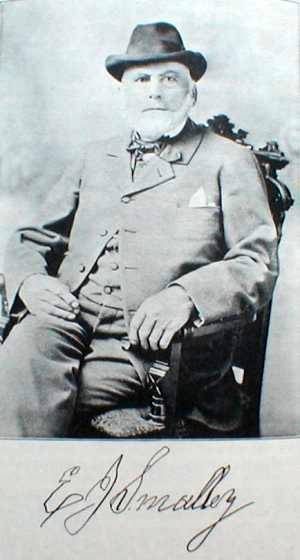 E.J. Smalley
